
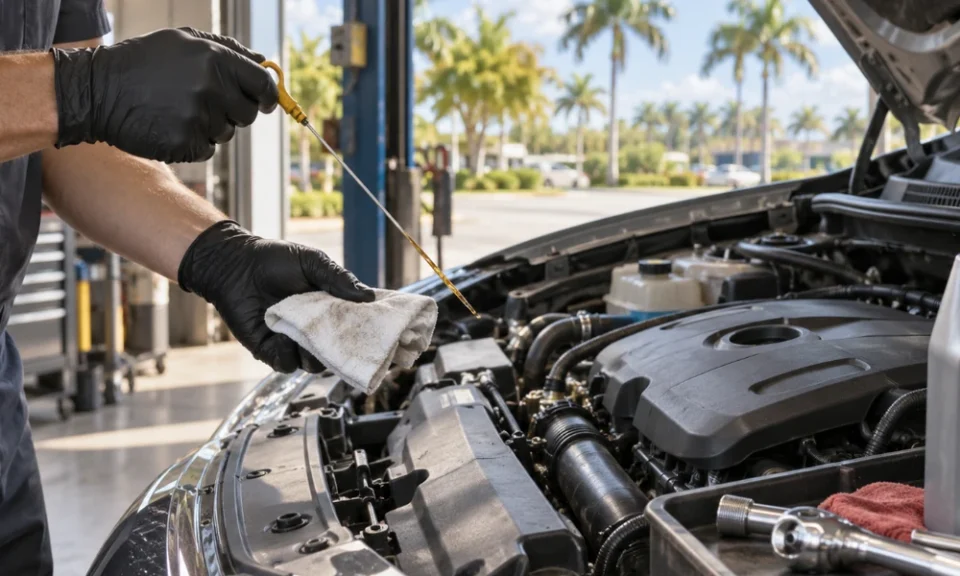
Florida drivers deal with heat, humidity, heavy traffic, and long periods of air-conditioner use. These conditions make many people wonder whether they need more frequent oil changes in Florida. The short answer is perhaps, but the weather alone does not decide the schedule. Your vehicle, oil type, driving habits, and maintenance instructions all matter.
Modern oil works across a wide range of temperatures, while the cooling system keeps the engine near its intended operating temperature. Still, demanding driving can cause oil to age faster.
Heat Can Put More Stress on Oil
Oil lubricates moving engine parts, carries away heat, and helps control deposits. High outside temperatures can add to the heat already produced inside the engine. When oil becomes extremely hot for long periods, it may oxidize and gradually lose some of its protective qualities.
This does not mean every Florida vehicle needs a very short interval. Oil that meets the manufacturer’s specification should handle normal warm-weather driving. However, an older engine, low oil level, cooling problem, or heavy use may increase the strain.
Driving Habits Matter More Than the Forecast
Many everyday driving patterns fit the severe-service category found in vehicle manuals. Short trips are one example. If the engine does not remain warm long enough, moisture and fuel may collect in the oil instead of evaporating.
Frequent idling and stop-and-go traffic matter too. The engine continues running when the odometer is barely moving, including during congested commutes and long waits with the air conditioner operating.
Towing, carrying heavy loads, driving on sandy or dusty roads, and making repeated low-speed trips can also justify more frequent oil changes in Florida. The combination of several conditions matters more than one hot afternoon.
Humidity and Storm Season
Humidity does not normally enter a sealed engine in large amounts. Still, condensation can form during short trips. Longer drives help the oil reach operating temperature and remove that moisture.
Floodwater is a different concern. If a vehicle travels through deep water, water may enter the engine, transmission, or other components. Milky-looking oil, a rising oil level, or unusual engine behavior after water exposure requires prompt professional attention. Simply waiting for the next scheduled oil change may risk serious damage.
Follow the Correct Maintenance Schedule
The owner’s manual remains the best starting point. Some vehicles list separate normal and severe schedules. Others use an oil-life monitoring system that estimates oil condition based on mileage, temperature, engine operation, and driving patterns.
Do not assume that every car should follow the same 3,000-mile rule. Depending on the vehicle and approved oil, the recommended interval may be much longer. At the same time, do not extend the interval simply because the oil still looks clean. Color alone cannot show whether its additives remain effective.
Check the oil level regularly, especially before long drives. Some engines consume oil between services. Running low can cause damage even when the oil itself has not reached the end of its recommended interval.
Signs You Should Check the Oil Sooner
Pay attention to an oil-pressure warning, oil-life alert, burning smell, visible leak, unusual engine noise, or sudden change in oil level. These signs require inspection and should not be handled by merely resetting the maintenance reminder.
More frequent oil changes in Florida may make sense when a vehicle spends much of its time idling, towing, making short trips, or operating under other severe conditions. For ordinary highway driving, the standard manufacturer schedule may still be suitable. Use the specified oil, monitor its level, and adjust the interval to the way the vehicle is actually driven.
This post was written by a professional at Tires2Go Florida. Tires2Go Florida is a trusted automotive service center located in Pinellas Park, Florida, serving drivers across St. Petersburg, Tampa, Clearwater, and Largo. Our certified mechanics handle tires online and wheel replacement, brake service, suspension repairs, oil changes, wheel alignments, tire balancing, and road force balancing. We also specialize in ADAS calibration, suspension modifications, lift kits, and lowering kits using quality parts and modern diagnostic equipment. From routine maintenance to advanced automotive services, Tires2Go Florida provides dependable solutions and tires for sale for vehicles throughout the Tampa Bay area.
